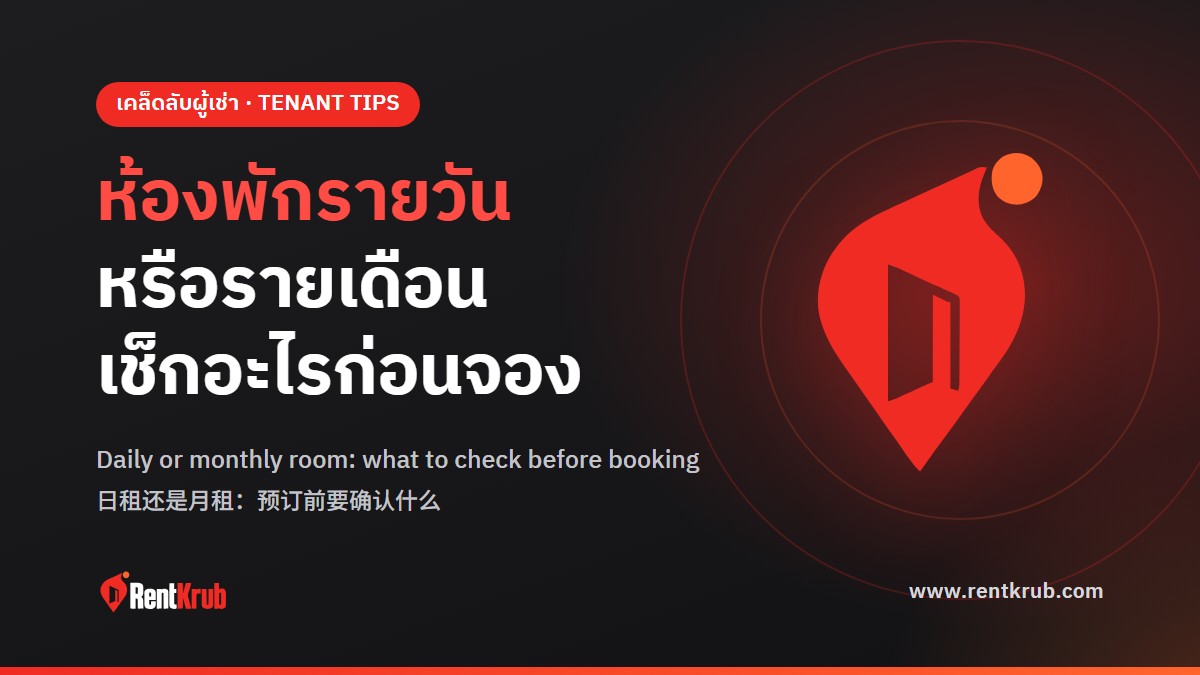
Coming to Thailand for a few days of work, an exam or a job interview, or waiting for your new apartment to be ready? A room by the day is flexible. Staying a month or more? Then a monthly rental is worth comparing. This guide explains who each option suits, the conditions to check before you book, the rules that apply, and how to find both on RentKrub.
Daily or monthly: the main differences
| Topic | Daily room | Monthly rental |
|---|---|---|
| Best for | A few nights to a few weeks | One month or longer |
| Paid up front | The nights you book; ask whether there is a deposit | Advance rent and a security deposit, as the lease says |
| Water and electricity | Ask whether they are included in the price | Ask the rate per unit, any monthly minimum and other fees |
| What you agree to | Booking details, price and cancellation terms | A written lease and a room-condition report |
| Main rules | Hotel Act B.E. 2547 (2004) | The lease, plus Thailand's 2025 lease rules if the landlord has 3 or more units |
Who each option suits
A daily room works well when you
- travel for work, training or a conference for a few nights
- come for an exam, an interview or a visit to a government office and want to stay close by
- are between homes, for example moving out before your new room is free
- want to try a neighbourhood before signing a longer lease
A monthly rental works well when you
- study or work in the area for a month or more
- want predictable monthly costs and a fixed address for deliveries
Staying one to six months? On RentKrub listing pages, the "Room types" table has a "Short lease" column, and some listings give prices for 1-, 3- or 6-month leases. If it is empty, ask the owner directly.
Hypothetical example: you need a place for three weeks. A daily room at 600 baht a night costs 600 × 21 = 12,600 baht, and you pay only for the nights you stay. A monthly room at 5,000 baht may ask for one month in advance plus a two-month deposit, 15,000 baht on signing day, plus utilities, and the lease may have a minimum term. Over 30 nights the daily room in this example would cost 18,000 baht, so the longer you stay, the more the monthly option makes sense. The deposit comes back when you move out if the room is undamaged and nothing is unpaid.
Are daily rentals legal in Thailand?
It depends on the operator. Thailand's Department of Provincial Administration explains that under the Hotel Act B.E. 2547 (2004), a "hotel" is a place set up as a business to give travellers or anyone else temporary accommodation for a fee, for stays shorter than a month. Places let by the month or longer fall outside that definition.
- Businesses renting rooms by the day need a hotel licence from the registrar. That duty lies with the operator, not the guest.
- Small places with no more than 8 rooms and 30 guests in total are not treated as hotels once they have notified the registrar, passed an inspection and received a notification receipt (Ministerial Regulation (No. 2) B.E. 2566 (2023)).
- Condo units let by the day: Thailand's Department of Lands has said this may amount to running a hotel, which needs a licence, and that unit use must follow the condominium's bylaws. Ask whether the building allows daily stays before you book.
Licensed hotels must display their licence and room rates where guests can see them, post fire-escape plans and emergency exit signs on every floor, and register each guest at check-in, so keep your passport handy.
For foreigners: under Section 38 of the Immigration Act B.E. 2522 (1979), the house owner, landlord or hotel manager who hosts a foreign national must notify the immigration authorities within 24 hours of arrival, using form TM30. Expect to be asked for your passport details for daily and monthly stays alike.
For monthly rentals, the lease governs. Landlords with 3 or more units must follow the Contract Committee's 2025 notification on residential leasing, in force since 04/09/2025: for leases of up to 3 years, advance rent and deposit together may not exceed three months' rent, and the deposit is due back immediately when the lease ends, or within 7 days if an inspection finds no damage. The notification does not cover hotels or dormitories under the Dormitory Act. The lease must be written in clear Thai, so ask for a translation of anything you cannot read.
The rules may change: on 29/09/2026 the Thai government put forward a draft Accommodation Act to replace the hotel law. It is still a draft and not in force, so this article describes the law as checked on 25/10/2026.
Checklist before you book
- What the price includes: per room or per person, extra guests, water, electricity, Wi-Fi, cleaning, bed linen, parking.
- Utilities: included in the daily price, or metered? For monthly rooms, the rate per unit and any minimum.
- Deposits: a key or key-card deposit for daily stays, and when it comes back; for monthly rooms, how many months of advance rent and deposit, with a receipt that names each payment.
- House rules: check-in and check-out times, late arrival, documents (passport), visitors, pets, smoking, cooking.
- Cancellation: how many days' notice for a full refund, date changes, and how and when refunds are paid. Get the terms in writing and keep chats, transfer slips and receipts until you check out.
- If you cannot settle a dispute: the Office of the Consumer Protection Board (OCPB) takes complaints on hotline 1166 or LINE @ocpbconnect.
Stay safe
- On RentKrub, the "Verified listing" badge means the RentKrub team checked ownership or management documents and the address. The "Licensed accommodation business" badge appears when the owner submitted an accommodation or hotel licence that the team checked.
- A listing marked "Not verified yet, please check before paying" is not necessarily untrustworthy, but view the room if you can, ask for ID and ownership papers, and transfer only to an account in the landlord's name. RentKrub never collects payments or deposits on behalf of a property.
- Read the reviews, check the location on the map, and use the "Report" button on a listing that looks wrong.
- On arrival, test the door lock and key card, find the fire exit nearest your room, and tell someone where you are staying.
Find daily and monthly rooms on RentKrub
The Daily rooms page lists short stays by province, near rail stations and near universities, with a "Monthly" and a "Daily" count next to each place. Tap "Daily" to see only listings with daily rates. Place names on the page are shown in Thai.
- Daily results near a station or university show the starting daily rent, room size and distance, with filters for price per day and amenities such as key cards, CCTV and security guards.
- Map search: drop a pin at your office, exam venue or hospital, set Rental type to daily or monthly (the options are labelled in Thai), and pick a radius of 1–5 km.
- Each listing's "Costs" section shows the monthly and daily prices, deposit, advance payment, water and electricity. "Ask the owner" means the figure is not listed, so ask before you book, and always confirm the price, availability and terms with the owner.
- Use "Compare" to see the costs of up to 4 places side by side.